> For the complete documentation index, see [llms.txt](https://clients.medianova.com/llms.txt). Markdown versions of documentation pages are available by appending `.md` to page URLs; this page is available as [Markdown](https://clients.medianova.com/products/performance-cdn/static-content-delivery/advanced-configuration/origin-settings/enable-gzip-from-origin.md).
# Enable Gzip from Origin
Fetch gzip-compressed text-based content from your origin to improve delivery efficiency.
Request gzip-compressed content from the origin to reduce data transfer between the origin server and the CDN.
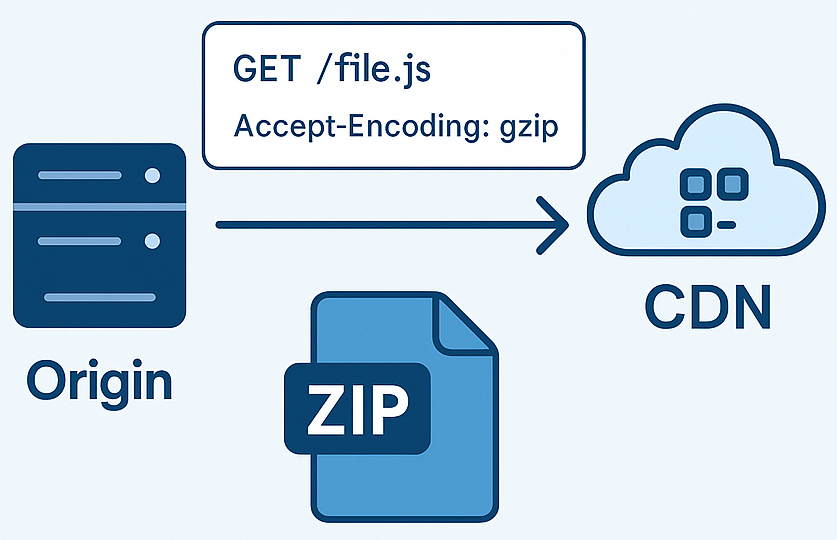
**Enable Gzip from Origin** configures the CDN to request eligible content from the origin using the following request header:
```http
Accept-Encoding: gzip
```
If the origin supports gzip compression, it can return a gzip-compressed response for the CDN to cache. If the origin does not return gzip-compressed content, the CDN uses the uncompressed origin response.
{% hint style="info" %}
Enable Gzip from Origin applies to the **origin → CDN** connection. It does not configure compression for responses delivered from the CDN to clients.
For client-side compression, see [How to Configure Gzip and Brotli.](/products/performance-cdn/static-content-delivery/advanced-configuration/compression/how-to-configure-gzip-and-brotli.md)
{% endhint %}
## How It Works
CDN requests gzip-compressed content from the origin when this feature is enabled.
When Enable Gzip from Origin is enabled:
1. The CDN includes `Accept-Encoding: gzip` when requesting eligible content from the origin.
2. The origin determines whether to return a gzip-compressed response.
3. If gzip compression is provided by the origin, the CDN stores the compressed response in cache.
4. If the origin does not provide gzip compression, the CDN stores the uncompressed response.
This configuration affects content retrieval from the origin and is independent of the compression configuration used for client delivery.
{% hint style="info" %}
This feature applies to supported text-based content. It does not apply to image compression or image format conversion.
{% endhint %}
## Enable Gzip from Origin
You can configure this feature for a CDN Resource in the [Medianova Control Panel](https://cloud.medianova.com).
{% stepper %}
{% step %}
### Open Origin Settings
Open your CDN Resource and select **Origin Settings**.
{% endstep %}
{% step %}
### Enable Gzip from Origin
Enable **Gzip from Origin**.
{% endstep %}
{% step %}
### Save the Configuration
Select **Save** in the pending changes bar.
Review the pending changes and confirm the update to apply the configuration to the CDN Resource.
{% endstep %}
{% endstepper %}
After the configuration is applied, the CDN requests eligible origin content with gzip support enabled.
## Important Notes
* The origin must support gzip compression to return gzip-compressed content.
* If the origin does not provide a gzip-compressed response, the CDN can use the uncompressed response.
* This setting controls compression negotiation between the CDN and the origin.
* Compression between the CDN and clients is configured separately.
---
# Agent Instructions
This documentation is published with GitBook. GitBook is the documentation platform designed so that both humans and AI agents can read, navigate, and reason over technical content effectively. Learn more at gitbook.com.
## Querying This Documentation
If you need additional information that is not directly available in this page, you can query the documentation by asking a question.
Perform an HTTP GET request on the following URL with the `ask` and `goal` query parameters:
```
GET https://clients.medianova.com/products/performance-cdn/static-content-delivery/advanced-configuration/origin-settings/enable-gzip-from-origin.md?ask=&goal=
```
`ask` is the immediate question: it should be specific, self-contained, and written in natural language.
`goal` is what the user is ultimately trying to achieve, the reason they need the answer. Sharing it helps GitBook give you a better, more relevant answer. A goal is most helpful when it describes the outcome the user wants rather than restating the question. For example, with `ask=how do I create an API token`, a goal like `automate deployments from our CI pipeline` lets GitBook tailor the answer to that use case.
The response will contain a direct answer to the question and relevant excerpts and sources from the documentation.
Use this mechanism when the answer is not explicitly present in the current page, you need clarification or additional context, or you want to retrieve related documentation sections.